
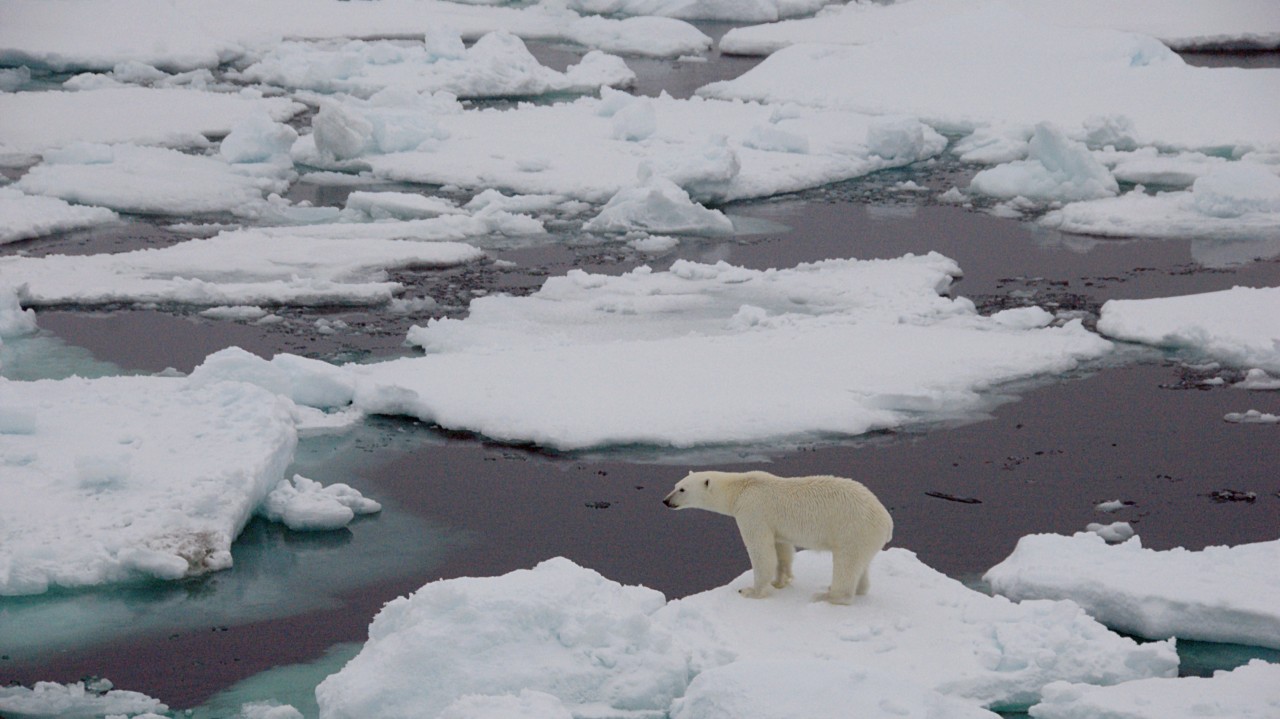
In February 2025, there was less sea ice on Earth than ever recorded. It’s the coldest time of year in the Arctic, and the freeze up of Arctic ice is nearing its maximum – but that maximum is looking small, significantly below the record lows for winter we saw in 2017.
In this edition of Beyond the Ice, polar climate scientist Dr Caroline Holmes explains what’s influencing these lows in Arctic sea ice, and how sea ice fits into the global climate.
Will the Arctic be ‘ice free in summer by 2100’? How do climate scientists actually come up with these headlines? What’s going on inside those predictive ‘climate models’ we always hear about? And what do you say to a sceptic who says we’ve seen this all before?
- Listen to the full discussion with Caroline here, or on your preferred podcast app
- Or read our summary of key points below
The discussion, in brief:
Sea ice that forms when the ocean surface freezes. As temperatures drop in the Arctic and Antarctic winter seasons, the area of sea ice covering each ocean region expands. This area of sea ice cover will decline in the summer season – and this natural ebb and flow happens each year. However, the scale and thickness of this sea ice is changing.
What role does sea ice play in Earth’s climate system?
Sea ice plays an integrated role in the balance of Earth’s natural processes. As Caroline explains, one basic yet important quality is being a vast area of white, rather than the dark blue of the ocean:
“That white surface, particularly when it’s covered by snow, reflects back the energy from the sun back to space – sunlight that would otherwise go into the oceans and heat up them up. So, sea ice helps keep the planet a little bit cooler than it would be otherwise.”
Sea ice effectively acts as a barrier between the ocean and the atmosphere. This affects how much heat and carbon moves between the atmosphere and the ocean. The difference between an ice-cooled sea surface and the heat absorbent dark of an ice-free surface can also affect air temperature, and therefore weather patterns.
A further impact on sea ice is the change in salinity it causes in the polar oceans, with consequences more widely:
“So when the sea ice forms from salty sea water, most of that salt doesn’t go into the sea ice. The salt stays in the water, and salty water is dense water. That dense water can then sink. It can then contribute to kind of how dense the ocean is in different places. And that forms dense bodies of water, which contribute to the global circulation of the ocean. Global ocean currents are all connected – so it’s really critical.”
Finally, polar ecosystems are intertwined with sea ice – from the hunting patterns of polar bears, to critical food-chain species like krill and copepods. Changes to sea ice stand to affect the whole ecosystem.
What has happened to sea ice in 2025?
Widely reported in news media, there are two record breaking moments taking place at the same time.
The first is that the combined amount of Arctic and Antarctic sea ice is at the lowest total extent on record. Over the five days to the 13 February, the combined extent was 15.76 million km², which is less than the previous low from January 2023, which was 15.93 million km².
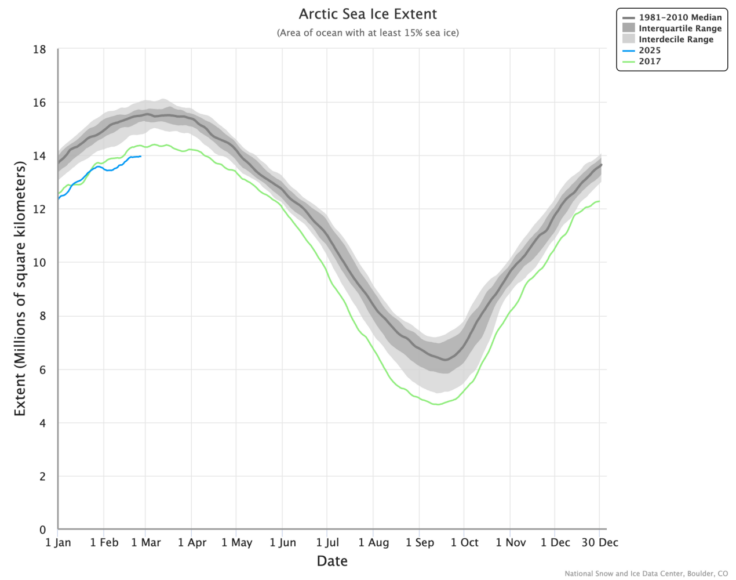
A ingredient of this statistic is the record-breaking low of Arctic winter sea ice, which makes up the majority of sea ice at this time of year. On 13 February, the area of Arctic sea ice was 13.64 million km², on track to under-shoot the previous 2017-low area of 13.93 million km².
What factors are causing lower levels of sea ice?
The oceans play a role in sea ice extent, and is particularly influenced by the ‘feedback’ loops caused by some changes to the bright white cover of regular sea ice:
“If, early in the summer as sea ice is melting, you kick that into action, you melt some ice earlier and you get melt ponds that are dark, then more heat is absorbed in those areas and this reinforces back to melt more ice. It’s becoming locally warmer.”
These feedback loops have been one of the factors that have seen the Arctic warming four times faster than the rest of the planet.
Another major influence is the atmosphere, and temperature. Arctic temperatures closely related to global temperatures – and 2024 broke all records. The Arctic Ocean is surrounded by landmasses – largely Canada and Russia, divided by relatively narrow areas where the Pacific Ocean and the Atlantic Ocean access the Arctic Ocean.
“For the atmosphere, it’s a question of how much warm temperatures can get up to the Arctic, influenced by local factors and weather. Strong winds coming up east of Greenland and east of Iceland can push ice up into the Arctic Ocean and also bring warm weather.”
These wind patterns can part of a natural changing pattern, which makes it hard to be specific about the causal factors behind specific wind events. However, Caroline pointed to the wider connection between temperatures and weather that we are certain about:
“Because of what we know about thermodynamics, we can say that increasing wind patterns like this are a part of climate change. The key point is that the Arctic is cold and the equator is warm. The jet streams and their strength are are affected by that temperature gradient. And so if you change that difference, then those strong winds will be affected, and this can affect more localised weather patterns.”
Current scientific consensus says that it’s likely the Arctic will be ice free in the summer by 2100. How do you go about estimating something like that?
Caroline began by clarifying that ‘ice free’ is used to mean that there would be less than 1 million km² of Arctic sea ice – roughly the area of Canada. This ice would be concentrated around the bordering coasts where it is currently very thick.
She also confirmed that ‘ice free’ periods would begin much sooner than that:
“It’s likely that the Arctic will be ice free in September, somewhere between 2030 and 2050. If we’re talking about 2100, then we might expect it to be ice free for several months of the year.”
Caroline explained the key modelling tool of climate scientists – Coupled Climate Models. These models take what we know about the physics, chemistry and biology of what drives Earth’s systems and represents them in equations. This method is also used for weather forecasting. There are lots of different models, put together with slightly different assumptions and methods. Scientists will use and compare a range of models in any analysis.
“If we’re doing a climate projection, then we take assumptions about how our emissions might change in the future. Typically we do a few of those. And so you run forward these these computer models under those different cases and they give you representations of how the future might look. This would give us a range of ideas for how sea ice is going to change in the future.”
“To arrive at a conclusion, you might give more weight to some models – they’re not opinions, but if you had a series of opinions from people, you might give some people opinions more weight based on what they know, and what their specialist background is. There are also statistical methods of weighting the contributions of different climate models.”
The language of probability is a central part of understanding major climate reports, such as those from the IPCC. The word ‘likely’ specifically means a 66% probability – that two times out of three, an event would happen.
How is sea ice extent data gathered, and how far back does it go?
Modern observations come from satellites. For sea ice extent hat’s just how much if you look down at the Earth, how much of the surface of ocean is covered by sea ice. And so they’re taken from satellite.
“Satellite observations of sea ice have been used since 1979. For extent, they measure something called passive microwave emissions. That means you’re not sending a signal from the satellite, just viewing the emissions using those to calculate how much, sea ice is there.”
So the best data we have is from satellites, because they’re able to give us a picture of the complete coverage of sea ice globally. However, there are other sources of sea ice data from before this era.
“The one good thing about whaling is that the whaling ships that were going into the Arctic, in the Antarctic would, take records of how much sea ice they saw. And particularly in the Arctic, a lot of the national meteorological institutes or similar would be measuring the amount of sea ice. So we’re very confident that back to 1850, these levels have not been seen before, in summer.”
Before 1850, we don’t have those direct measurements, but scientists can estimate extent using ‘proxies’ – such as records in sediments of local temperatures. This works because of the strong link between sea ice and temperature. This data offers less certainty, but does give an overall view of the conditions of those regions over time.
Why are scientists so certain that humans have had an influence on sea ice extent?
Given the limited scope of sea ice extent data, Caroline explained how climate models can give us greater certainty that human-induced carbon emissions are effecting modern sea ice levels:
“We still have ways of saying that we’re confident there’s a human influence on this sea ice change. Another thing that you can do with climate models is to run scenarios of historic dates without human carbon emissions. We know what humans have emitted. And again, if you run these models without any emissions, and if you do them carefully, and if you use lots of different models, you can say, ‘well, okay, is there any way of getting the kind of sea ice loss that we’ve seen?'”
“So you’re looking at what could have happened in an alternative reality, and looking at the probably of the event happening in those conditions. Then you’re comparing that to the probability of the event under current emissions – checking the workings of the model against reality.”
“This is called an attribution study. People do it quite a lot now for extreme events – ‘was this event affected by climate change?’ And in the Arctic, we’re fairly confident that most sea ice loss in the Arctic has been due to human influence since 1979.”
Is it now too late to avoid the continued decline of Arctic sea ice?
Caroline gave a balanced but hopeful picture about the future of sea ice:
“A lot of the early stuff – for the 2030s, the 2040s – is baked in. It’s now hard to change what we expect to happen in the next couple of decades, and it isn’t really strongly affected by which of the emissions pathways we follow. The Arctic is already changed.”
“But in the longer term, we really do have the agency to change this. If you look to the end of century, there’s a big difference in how much the ice will be left in the Arctic for each emissions pathway, and over how many months. We’re talking about that season length – how long the sea ice is there for each season.”
“And actually, in the amazing world where we managed to go to net zero or reduce the amount of carbon in the atmosphere, theoretically, sea ice could recover in the Arctic. We’re probably not going to get to that point. But it’s it’s not baked in. We certainly have agency to, slow down the rate of change, and to somewhat limit how big those changes are.”