
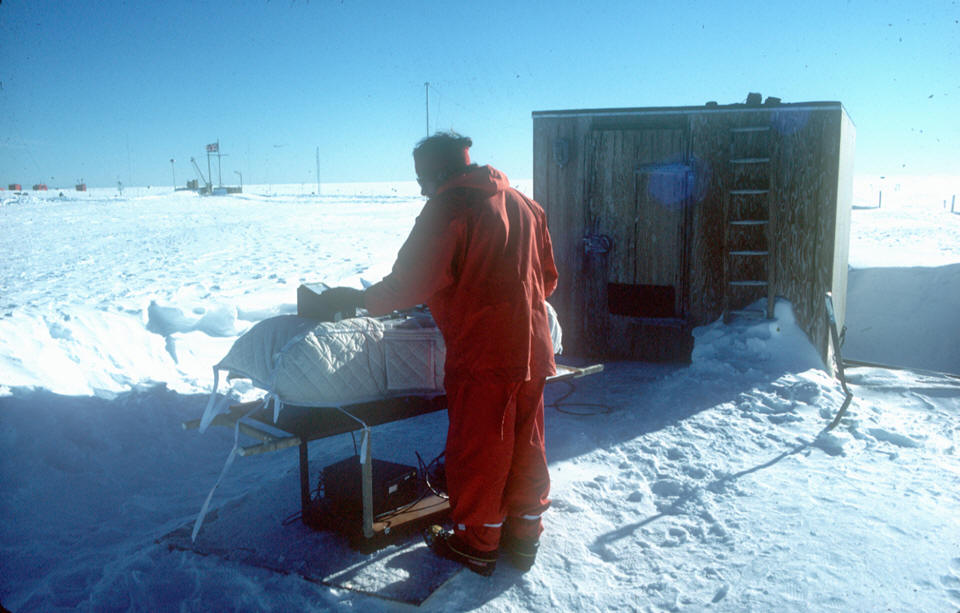
Forty years ago, British Antarctic Survey scientists made a world-changing discovery: a hole in Earth’s protective ozone layer above Antarctica.
What lessons can this remarkable story of scientific discovery, political action and environmental recovery teach us about tackling today’s climate crisis? And how close are we to seeing the Antarctic ozone hole finally close?
In this edition of Beyond the Ice, British Antarctic Survey meteorologist Jonathan Shanklin recounts finding that routine ozone measurements from Halley Research Station were literally ‘falling off the graph’ – the first evidence linking chlorofluorocarbons to ozone depletion. Professor John Pyle explains how this evidence led to the Montreal Protocol, now ratified by every country worldwide and hailed as the most successful international environmental agreement ever. Atmospheric chemist Professor Lucy Carpenter brings us up to date: the ozone layer is recovering but faces challenges from climate change and extreme wildfires.
The discussion, in brief:
Today, Friday 16 May, marks the 40th anniversary of the discovery of the ozone hole above Antarctica. Published in the journal Nature in 1985, this groundbreaking paper by British Antarctic Survey scientists revealed how human emissions were causing a dangerous hole in Earth’s protective atmospheric layer. The discovery led to one of the most successful global environmental agreements ever – the Montreal Protocol.
The Discovery: When Data Fell Off the Graph
Jonathan Shanklin, one of the scientists who made the discovery, explains how routine measurements at Halley Research Station in Antarctica revealed something was seriously wrong:
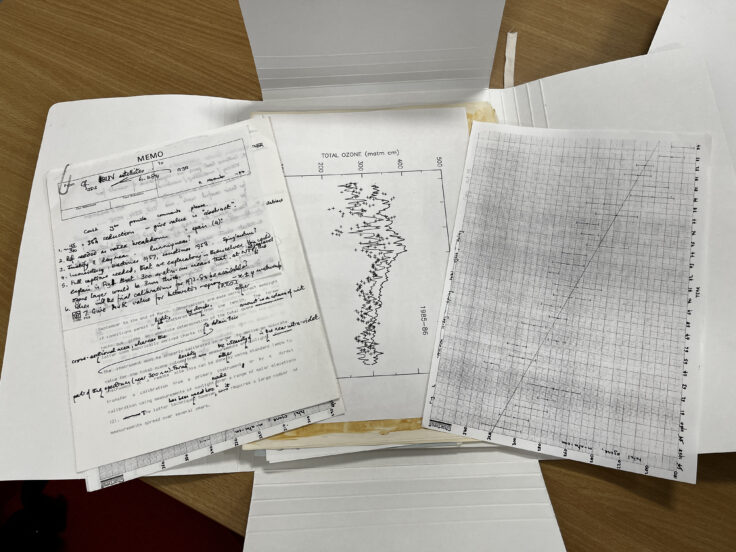
“The problem was the points were starting to fall off the top of the graph. Quite unusual in science, really. In the end, I plotted up all the data and was able to show that the springtime ozone lines over Halley Station were getting systematically lower year by year. And it was that that told an unsuspecting world that there was a link between the declining ozone over Antarctica and the increasing chlorofluorocarbons in the atmosphere.”
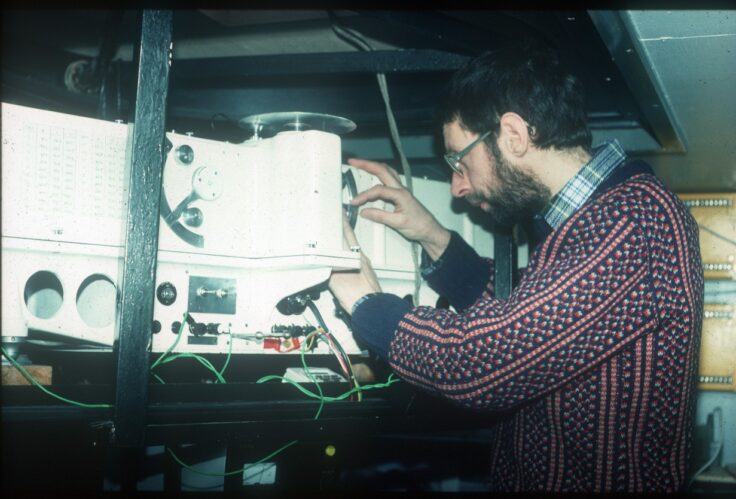
Shanklin’s scientific journey took an unexpected turn when he initially doubted the connection between human activities and ozone depletion:
“At about this time, there were concerns that the exhaust gases from Concord and spray cans and foam in upholstery and refrigerants would destroy the ozone layer. And me, being a naive young scientist, thought what? No rubbish. That’s highly unlikely, isn’t it? But we had this open day coming up, and I thought I’ll put the latest data that I’ve just analysed on the graph, and show that people don’t need to worry about all of these things.”
The ozone depletion was occurring because of special conditions in the Antarctic:
“It was all to do with these beautiful clouds that form during the Antarctic winter, where it gets very cold in the centre of the ozone layer and on the surface of those clouds, chemical reactions can take place that convert the chlorine from the chlorofluorocarbons into an active form, so that when the sun comes back in the Antarctic spring, ozone is destroyed at about 1% a day.”
Political Action: The Montreal Protocol
Professor John Pyle, an atmospheric scientist from the University of Cambridge who served as co-chair of the Scientific Assessment Panel for the Montreal Protocol, explains the significance of the discovery:
“I think it’s difficult to overestimate the importance of the paper that was published 40 years ago. It was one of the key geophysical papers of the 20th century… The paper was the first to actually show that ozone was being destroyed, where the depletion was happening, and the time of the year at which it was happening was a complete surprise to the scientific community.”
Scientific confirmation came quickly, cementing the case for global action:
“These are data taken by the Americans in 1987, so two years later. They flew that converted U-2 spy plane very high in the atmosphere in that region… As they flew further south into the region where these very low temperatures were, those polar stratospheric clouds might be, we see a big drop off in the ozone and it’s anti-correlated with chlorine monoxide.
This was known as the smoking gun. And this paper was published at almost exactly the same time that the Montreal Protocol came into existence.”
The discovery led to swift scientific and political action:
“Kofi Annan called it perhaps the single most successful international agreement to date. Really important. There are some key parts of why the Montreal Protocol was successful. First of all, every country in the world eventually ratified the treaty… Another key feature of the protocol was the recognition that countries with developing economies needed financial assistance in moving away from CFC to other compounds or other technologies. The multilateral fund was set up – to date more than 4 billion US dollars has been spent helping those poorer countries.”
Recovery and current challenges
Professor Lucy Carpenter, an atmospheric chemist at the University of York, explains how the ozone layer is responding to the Montreal Protocol’s controls:
“The good news is that the ozone layer is still recovering due to the Montreal Protocol. Essentially, if we keep reducing ozone depleting substances in the way that we are, these exceptional events will have less of an impact on the ozone hole and on the ozone layer. Ozone should recover mid-latitudes and globally by around the middle part of this century – and a few years later in Antarctica.”
However, recent years have seen some unexpected challenges:
“2021, 2022 and 2023 were all consecutive years where actually the ozone hole was incredibly large. And so here we were on a path to recovery. And yet we are seeing very large ozone holes in recent years… We think that one of the reasons for that are the enormous wildfires that happened in the northern hemisphere, in Siberia and in the Southern hemisphere and Australia. Those fires were so intense that they lofted huge amounts of smoke and smoke-filled aerosols right up into the stratosphere.”
PlayThe 2023 Antarctic ozone hole reached its maximum size at 10 million square miles, or 26 million square miles on 21 September, which ranks as the 16th largest since 1979.
The Legacy of the Montreal Protocol
The Montreal Protocol has not only helped save the ozone layer but has had significant climate benefits as well:
“It’s thought that essentially if there’d been no Montreal Protocol, by the end of the century, by 2100, about 80% of the total ozone would be destroyed. And that would lead to a huge increase in the level of dangerous UV radiation. By 2030, that could have led to another couple of million cases of skin cancer per year.
And also, many of these gases are greenhouse gases… We may have seen a couple of degrees increase in climate warming by 2100. That would be very significant indeed, coming on top of the increases that we would get from CO₂ and other greenhouse gases.”
The success of the Montreal Protocol offers valuable lessons for tackling today’s climate challenges – demonstrating how scientific discovery can lead to effective global action when supported by political will and international cooperation.