
Scientists from British Antarctic Survey have contributed to research that significantly improves predictions of future precipitation – rainfall and snowfall – in High Mountain Asia, a region that provides water to 1.9 billion people.
The new study introduces a machine learning approach that delivers more nuanced climate predictions essential for water security planning.
High Mountain Asia contains the largest amount of frozen water outside Earth’s polar regions. The frozen glaciers are an essential source of water for people living downstream in Pakistan, India, Nepal and Bhutan, for example, and many lives and livelihoods are dependent on these natural reservoirs. However, as the climate warms and glaciers melt, this source of meltwater will become much scarcer.

Mountain lakes in the Himalayas taken during the Big Thaw expedition. Credit: Dr Hamish Pritchard and Dr Federico Covi, British Antarctic Survey
The innovative research addresses this challenge by developing a sophisticated “probabilistic framework” – a method that calculates how likely different outcomes are – to better understand future precipitation patterns.
“Having accurate probability distributions over possible changes allows policymakers to have a more nuanced view of climate change,” explains Kenza Tazi, a climate scientist and lead author of the study. “This helps them better allocate limited resources to build sustainable infrastructure and avoid maladaptation.”
The research team used artificial intelligence combined data from 13 different regional climate models to reveal new patterns in future precipitation. This approach (called a “mixture of experts” (MoE)) resulted in a remarkable 254% improvement in precipitation predictions compared to individual models, and a 32% improvement over equally weighted model averages (where the average is combined from several different models).
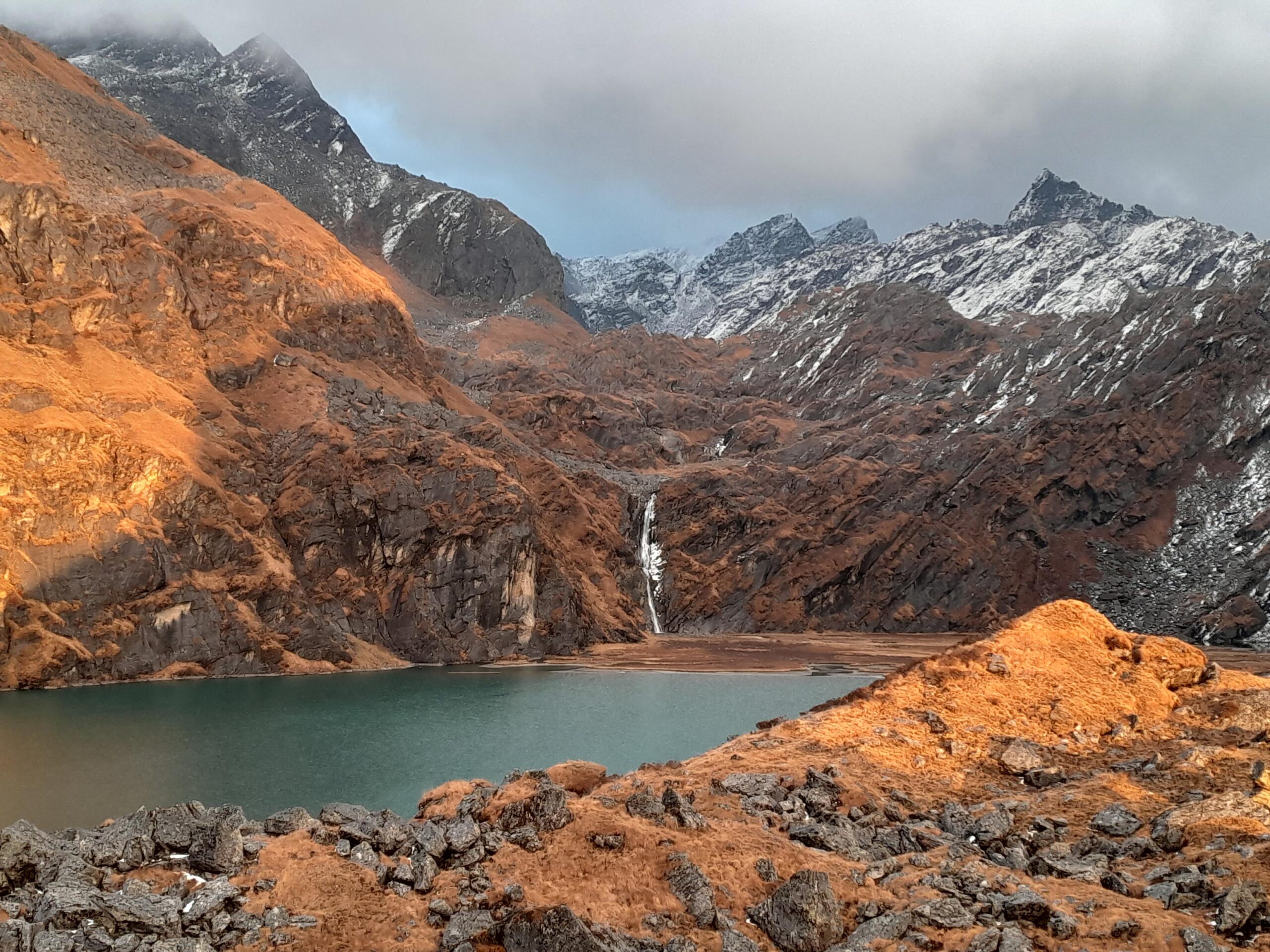
Mountain lakes in the Himalayas taken during the Big Thaw expedition. Credit: Dr Hamish Pritchard and Dr Federico Covi, British Antarctic Survey
The study revealed that the western Himalayas and Karakoram mountains may experience wetter summers but drier winters, factors which are likely to increase water scarcity as mountain ice reserves dwindle. Areas like the Tibetan Plateau, Hengduan Shan, and southeast Tibet could see increased winter precipitation.
These detailed projections cover both the near-future (2036-2065) and far-future (2066-2095) under different scenarios, providing crucial data for regional planning.
The research also highlights areas where climate models disagree, or are less reliable in predicting precipitation. This information helps climate scientists direct efforts for improving these models and guides policymakers on where to exercise caution when making water management decisions.
As climate change continues to change precipitation patterns around the world, this valuable research demonstrates how advanced data science can help communities prepare for an uncertain future.
Refined climatologies of future precipitation over High Mountain Asia using probabilistic ensemble learning by Kenza Tazi et al is published in Environmental Research Letters.