
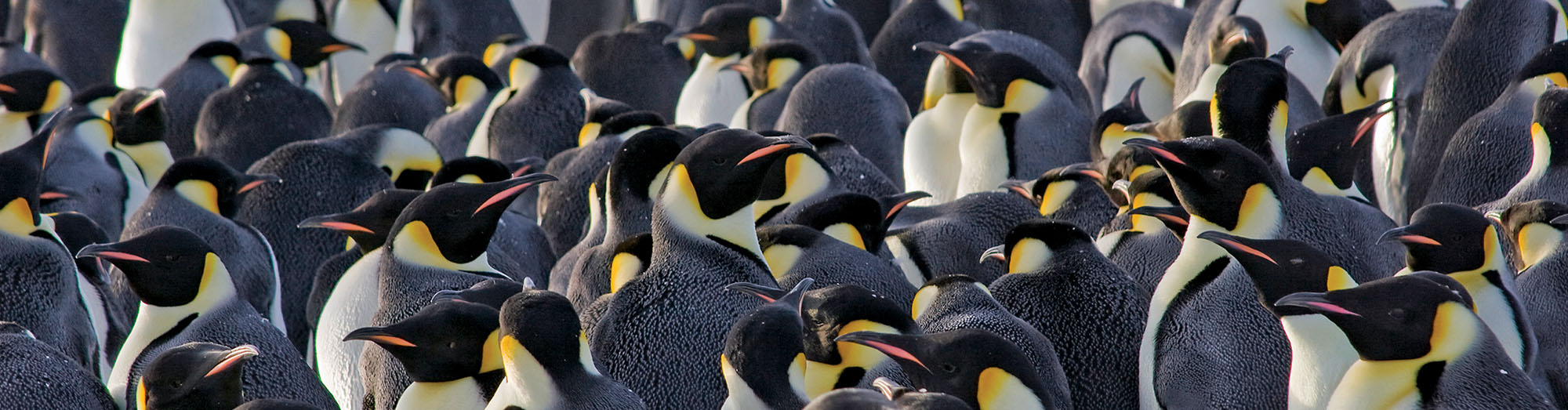
Protecting the emperor penguin
Emperor penguins breed in total darkness, in temperatures that can plunge to -50°C, on sea ice that forms and melts with the Antarctic seasons. They have done so for millions of years. But the ice they depend on is disappearing and the speed of change is outpacing everything the species has faced before.

BAS has been at the centre of the scientific effort to understand what is happening and to turn that knowledge into action.
In 2009, BAS researchers made a discovery that transformed the field: emperor penguin colonies could be identified in satellite imagery, their presence visible as dark patches of droppings (guano) against white ice from hundreds of miles above the Earth.
For the first time, scientists could locate colonies across the entire Antarctic coastline without having to reach each one on the ground. Researchers then commissioned very high resolution satellite images and in 2012 an international team led by BAS completed the first ever comprehensive census of any species from space. It counted an estimated 595,000 emperor penguins and provided a benchmark against which future change could be measured.
That satellite evidence helped inform the emperor penguin’s move from Least Concern to Near Threatened on the IUCN Red List (the world’s most comprehensive information source on the conservation of animal plant and fungi species) in 2012. It also created the foundation for a new era of continent-wide monitoring.
The satellite record soon began to reveal an unfolding crisis.
In 2011, BAS scientists reported the disappearance of the Dion Islands colony during a period of regional Antarctic warming – the first recorded loss of an emperor penguin colony in recent times.
At Halley Bay, repeated sea ice failure later caused the sudden collapse of what had been one of the world’s largest emperor penguin colonies. The findings, published in 2019, demonstrated that even large and long-established populations could be gone almost overnight when their breeding habitat disappeared.
BAS researchers also helped lead the modelling that showed what was at stake. Their work found that, without rapid action to curb warming, the global population of emperor penguins could fall dramatically this century. In 2020, a major international review led by BAS researchers recommended that the species should be reclassified as Vulnerable and listed as an Antarctic Specially Protected Species under the Antarctic Treaty system.
Since then, the evidence has become more compelling.
In 2022, sea ice in the central and eastern Bellingshausen Sea broke up before emperor penguin chicks were ready to leave their colonies. BAS analysis published the following year found that four of the region’s five known colonies were likely to have experienced total breeding failure – the first recorded example of such widespread breeding failure clearly linked to large scale sea-ice loss.
In 2026, BAS researchers reported the first identification of moulting emperor penguin groups from space. The study found that, during the record low sea ice years of 2022 to 2024, ice in Marie Byrd Land broke up before some penguins were likely to have completed their moult. Entering the ocean without fully waterproof feathers could expose them to exhaustion, hypothermia and predators.
Researchers cannot yet say exactly how many birds died or whether some found new moulting sites. But the potential loss of adults is particularly serious: emperor penguins can live for up to 20 years, do not begin breeding until they are several years old and depend on high adult survival to sustain their populations.
This growing body of evidence has reshaped the global conservation picture. Satellite observations suggest that emperor penguin numbers fell by around 10% between 2009 and 2018. More recent BAS research found a 22% decline over 15 years in a region containing almost one-third of the global population. Climate projections indicate that the global population of emperor penguins could halve by the 2080s unless there are rapid reductions in greenhouse gas emissions.
The UK has repeatedly used this evidence to press for the emperor penguin to be designated an Antarctic Specially Protected Species. Although international agreement has not yet been reached, the scientific case has continued to grow.
In April 2026, following the latest BAS evidence on sea-ice loss, breeding failure and threats to moulting adults, the IUCN formally reclassified the emperor penguin as Endangered.
From a dark mark spotted in a satellite image to nearly two decades of continent-wide monitoring, BAS has transformed what the world knows about emperor penguins. Its science has revealed the scale and speed of their decline, informed international conservation decisions and given governments the evidence they need to protect a species running out of ice.