
British Antarctic Survey (BAS) delivers world-leading research in some of the most remote and environmentally challenging locations on Earth. From our headquarters in Cambridge to research stations and field camps across Antarctica and South Georgia, our science helps the world understand climate change and its impacts on the environment and biodiversity.
However, operating on a global scale carries its own environmental impact, which we are committed to minimising.
Our Net Zero Strategy sets out how we will reduce greenhouse gas emissions across our operations while continuing to deliver world-leading polar science.
Our net zero ambition
We are committed to achieving net zero greenhouse gas emissions by 2050, supporting UKRI and NERC as we work towards a more sustainable research sector. This requires action across our estates, infrastructure, logistics, shipping, aviation, procurement, energy systems and ways of working.
How we’ll do this:
- Reducing energy demand through efficient buildings and operations.
- Increasing the use of renewable energy.
- Exploring sustainable fuels and low-carbon technologies.
- Improving carbon reporting and decision-making.
- Embedding sustainability within our culture.
- Collaborating with partners across the polar and research communities.
British Antarctic Survey 2025-26 carbon footprint
2025/26 was a year of significant progress for BAS’s Net Zero programme. We reduced our emissions across our polar operations, and completed work that will allow longer-term transformation.
Our reportable carbon footprint for April 2025 to March 2026 was 22,412 tonnes of carbon dioxide. That’s roughly the same as the average energy use of 7,004 UK homes for a year. This is down 6% from 23,847 tonnes in 2024-25, and 20% down on our 2017-18 baseline.
Our total carbon footprint for April 2025 to March 2026 was 44,975 tonnes of carbon dioxide. That’s roughly the same as powering 14,055 average UK homes for a year. This is down 10.1% from 50,018 tonnes in 2024-25.
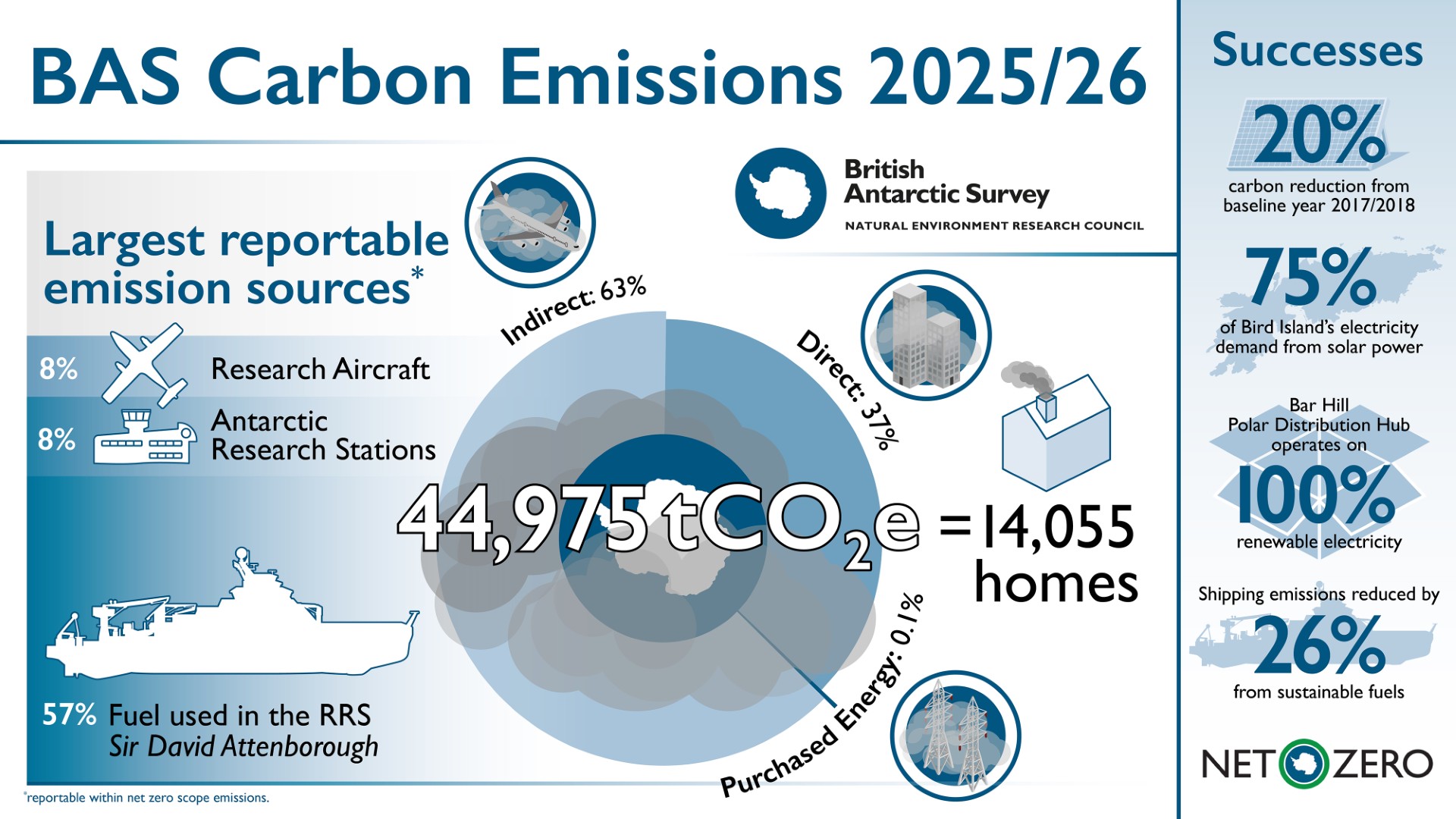
Progress highlights are shown in the table below:
| Area | 2025/26 progress | Why it matters |
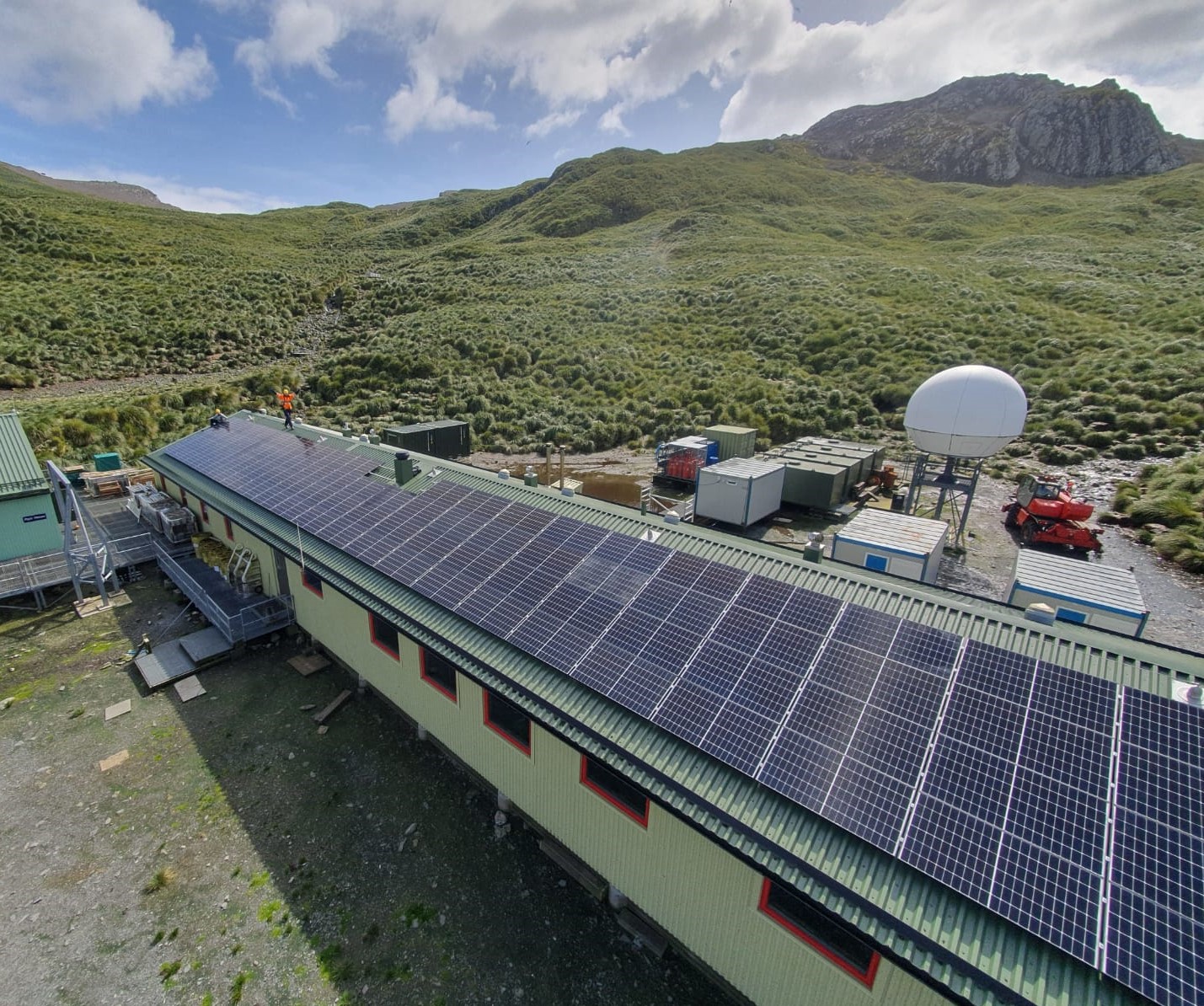
| Bird Island research station solar | 75% lower generator fuel use and 51% lower total station fuel use | Demonstrates the potential of renewables in remote polar environments. |
| Cambridge HQ solar | Around 25% of annual electricity demand generated on site | Reduces reliance on grid electricity and supports lower-carbon headquarters operations. |
| Bar Hill Polar Distribution Hub electricity | 100% renewable electricity | Supports lower-carbon operation across the wider BAS estate. |
| Rothera Research Station new Discovery Building | BREEAM Outstanding and expected 25% fuel-use reduction | Shows how infrastructure investment can improve resilience and reduce operational emissions. |
| Carbon Literacy | 269 colleagues certified and Silver accreditation achieved | Builds organisational capability and embeds practical climate action. |
Sustainable infrastructure
Through the Antarctic Infrastructure Modernisation Programme, we are working to create facilities that are more efficient, resilient and sustainable while supporting scientific excellence.
A major milestone was the completion of the new Rothera Discovery Building, which achieved BREEAM Outstanding certification. The building, alongside new site-wide energy services, is expected to reduce fuel use by approximately 25% while providing a modern, resilient facility to support Antarctic science.
Transforming logistics and operations
Logistics are one of the most significant contributors to BAS emissions.
Over the past year, we expanded the use of alternative sustainable fuels in charter shipping operations and continued to investigate other ways to reduce emissions from maritime logistics. Our wider Net Zero programme is increasingly focused on innovative approaches, including using AI technology to make our logistics more efficient.
Independent recognition
Our approach to decarbonisation is receiving increasing external recognition.
In 2025/26, we achieved Carbon Trust certification, recognising our commitment to emissions reduction.
We were also shortlisted in the Decarbonisation Strategy of the Year category at the edie Energy & Tech Awards 2026, recognising our leadership in tackling emissions across one of the world’s most challenging scientific operating environments.
Why our approach is succeeding
- Aligning the whole organisation: a clear Net Zero Strategy that connects estates, operations, logistics, infrastructure and culture.
- Investment in practical solutions: renewable energy, efficient buildings, and sustainable fuels are being used where they can make a measurable difference.
- Better data and reporting: improved carbon reporting supports evidence-based decisions and helps prioritise our efforts.
- Innovation: AI-enabled logistics, operational efficiencies, alternative fuels and new technologies help address complex emissions sources.
- Staff engagement: Carbon Literacy training and Net Zero Week help build capability, awareness and ownership across the organisation.
Looking ahead
The transition to Net Zero is a long-term transformation rather than a single project.
Over the coming years, we will continue to focus on reducing emissions across shipping, aviation, estates and infrastructure while investing in renewable energy, sustainable fuels, innovative technologies and organisational capability.
Our approach demonstrates how research organisations can reduce their carbon footprint without hindering their ability to carry out world-leading science.