
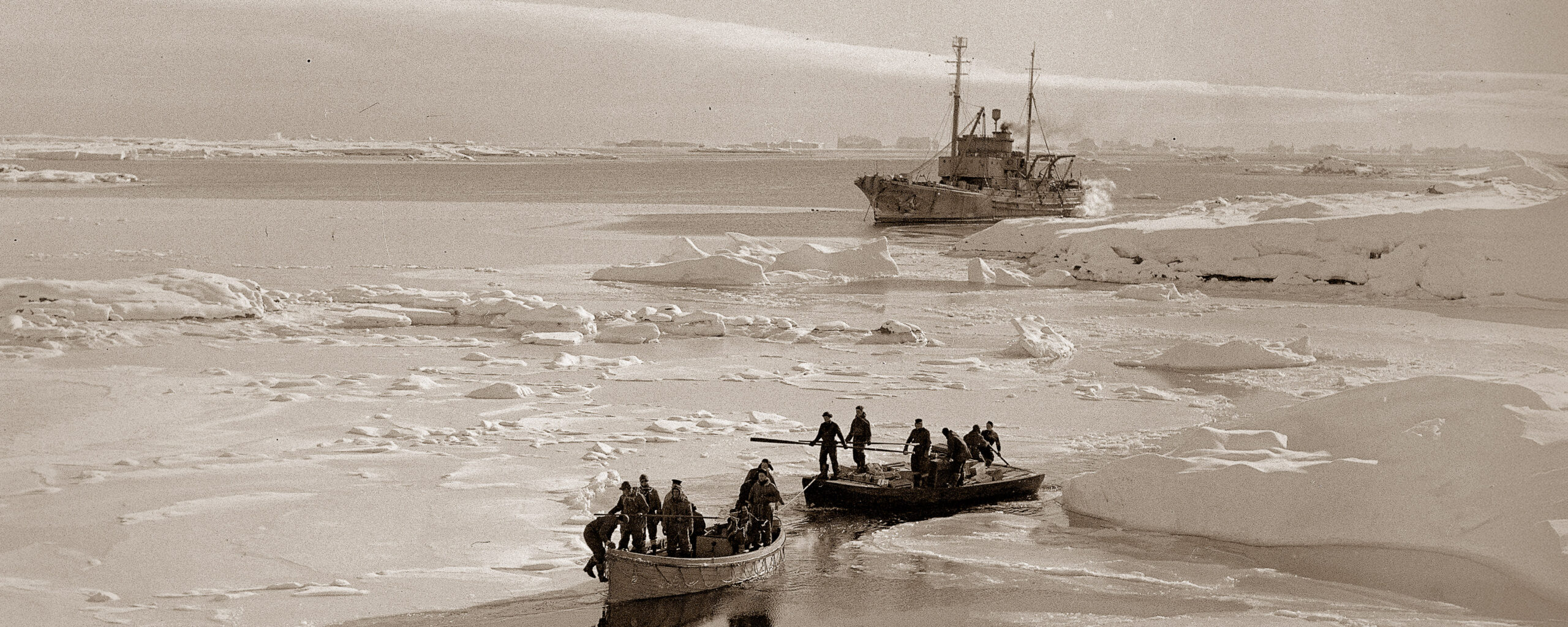
Ice-strengthened ships and experienced crews have been central to our Antarctic work since 1943. Initially, our ships helped establish bases and deliver staff, supplies, and mail. They also allowed scientific teams to reach otherwise inaccessible locations.
Ship officers have long carried out hydrographic surveys and sea ice observations. These tasks made navigating icy and poorly charted waters safer.
Early ship support
During Operation Tabarin (1943–1945), the Admiralty provided ship support. This included an ice-strengthened Royal Navy vessel, a local Falkland Islands supply ship, and a chartered ship from the Dominion of Newfoundland.
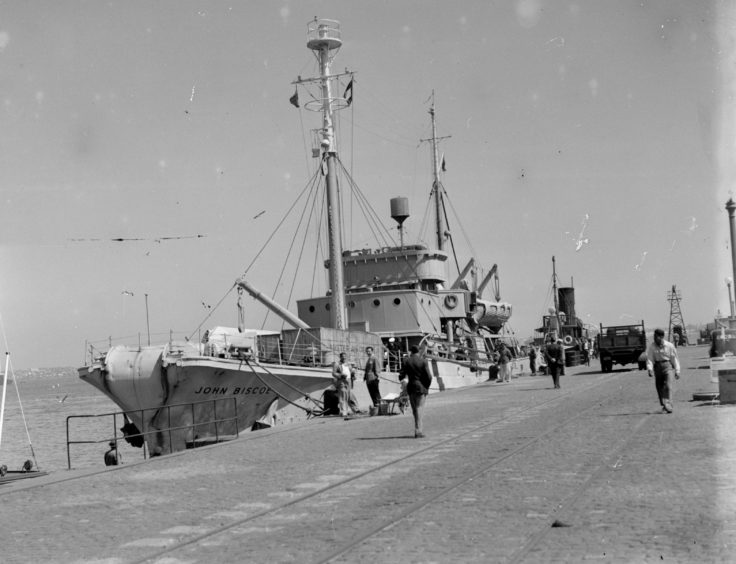
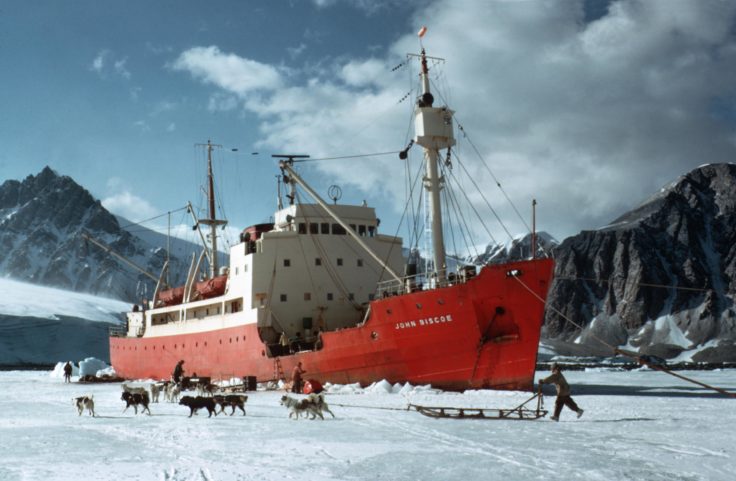
In 1947, the newly formed Falkland Islands Dependencies Survey (FIDS) purchased its first vessel, the MV John Biscoe. Since then, new polar ships have been named after earlier vessels or individuals linked to polar exploration.
MV/RRS John Biscoe
The MV Pretext was the first ship to be purchased by the Falkland Islands Dependencies Survey (FIDS) in Aug 1947 for approximately $75,000. Previous to this, the vessel had been used as a net-laying ship during the Second World War. Renamed the MV John Biscoe, the ship was used by FIDS as a supply vessel to re-stock bases and exchange personnel. In 1953, the John Biscoe was awarded the status of RRS (Royal Research Ship). On arriving back in Southampton on 12 Jun 1956, she was replaced with a new purpose-built vessel, also named the John Biscoe. To avoid confusion with the new ship, the original Biscoe was renamed Pretext from 24 April 1956.
Naming
Named after the English 19th-century sea captain, John Biscoe (1794-1843). In 1830, Biscoe was given command of the Tula by Enderby Brothers of London. Combining exploration with the search for new sealing grounds, Biscoe circumnavigated the Antarctic continent, discovering Enderby Land in 1831, Adelaide Island and the Biscoe Islands in 1832, as well as part of the west coast of the Antarctic Peninsula, naming it Graham’s Land (now Graham Coast).
Technical specification
Wooden motor vessel of 870 tons gross (416 tons net), ice-strengthened, with diesel electric engines. Maximum speed of 12 knots. Classed as A1 survey vessel. Complement 30 crew, 12 passengers. Greenheart sheathing fitted to hull 1948-9.
Port of registry
Stanley, Falkland Islands
Post-BAS service
The RRS John Biscoe was sold to the New Zealand Government for £12,000, who took ownership in Aug 1956. She was renamed the HMNZ Endeavour and used as a support vessel during the New Zealand contribution to the Commonwealth Trans-Antarctic Expedition.
HMS/RRS William Scoresby
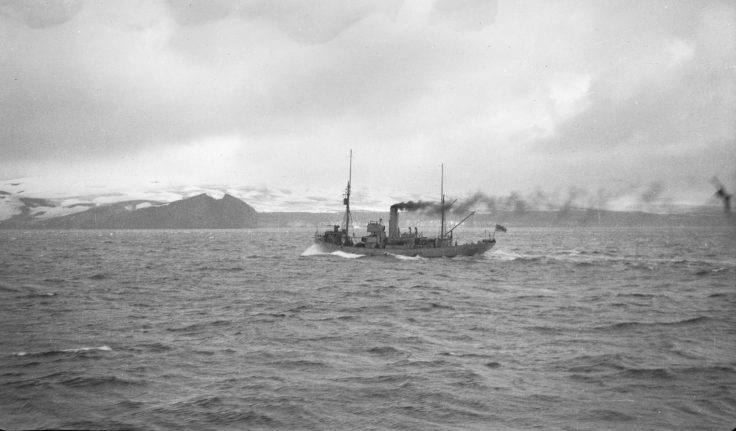
Launched in 1926, the William Scoresby was built by Cook, Welton & Gemmell Ltd as an oceanic research vessel for use during the Discovery Investigations from 1926-1938. Designed along the same lines as a whale catcher she was equipped with a scientific laboratory and trawling equipment to conduct surveys and whale-marking.
In Oct 1939 she was requisitioned by the Admiralty (and designated HMS) for service in the Falkland Islands and Dependencies, and stationed in the Falkland Islands from June 1940. From 1943-46, the William Scoresby supported Operation Tabarin – a secret Second World War expedition to the Antarctic organised by the British Government. Under Captain Victor Marchesi, the Scoresby acted as escort, personnel transport and mail ship, supporting the establishment of permanent British bases at Deception Island, Port Lockroy and Hope Bay. Service under the Admiralty ceased in Sep 1946.
Technical specification
- Ice-stengthened
- Dimensions: length 134 feet; beam 26 feet
- Gross tonnage: 324 tons
- Speed: 12 knots
Naming
The former whale-marking vessel was named after William Scoresby, 1789-1857, son of a Whitby whaler. Scoresby commanded numerous whaling voyages in the Arctic regions, combining the search for whales with contributions to scientific knowledge of Arctic seas, as well as charting and mapping the coast of East Greenland.
Post BAS life
Following Tabarin, the RRS William Scoresby was used by the National Institute of Oceanography in the Southern Ocean in 1951. In 1954 she was sold-off to British Iron and Steel Corporation for scrap and broken up Sutton Harbour, Plymouth.
About the Discovery Investigations
The Discovery Investigations were a series of marine biology and oceanographic surveys undertaken from 1925-1951 under the auspices of the Colonial Office, and managed by the Discovery Committee. The Committee was established to carry out the recommendations made in a Report of the Interdepartmental Committee on Research and Development in the Dependencies of the Falkland Islands (1920), which reviewed marine resources in the Southern Ocean and the need to monitor them and their environment in the light of rapid expansion of the whaling industry. The archives of the Discovery Investigations are held by the National Oceanographic Library.
Royal Research Ship status and fleet growth
In 1953, FIDS vessels were granted Royal Research Ship (RRS) status. A second ship, RRS Shackleton, was purchased in 1955. The first purpose-built support vessel, RRS John Biscoe, replaced her namesake in 1956.
Charter vessels were used as needed until 1970, when the newly built RRS Bransfield replaced RRS Shackleton. In 1978–79, RRS John Biscoe was refitted for deep-sea research. She was replaced in 1991 by RRS James Clark Ross, the first BAS vessel built as a dedicated science platform.
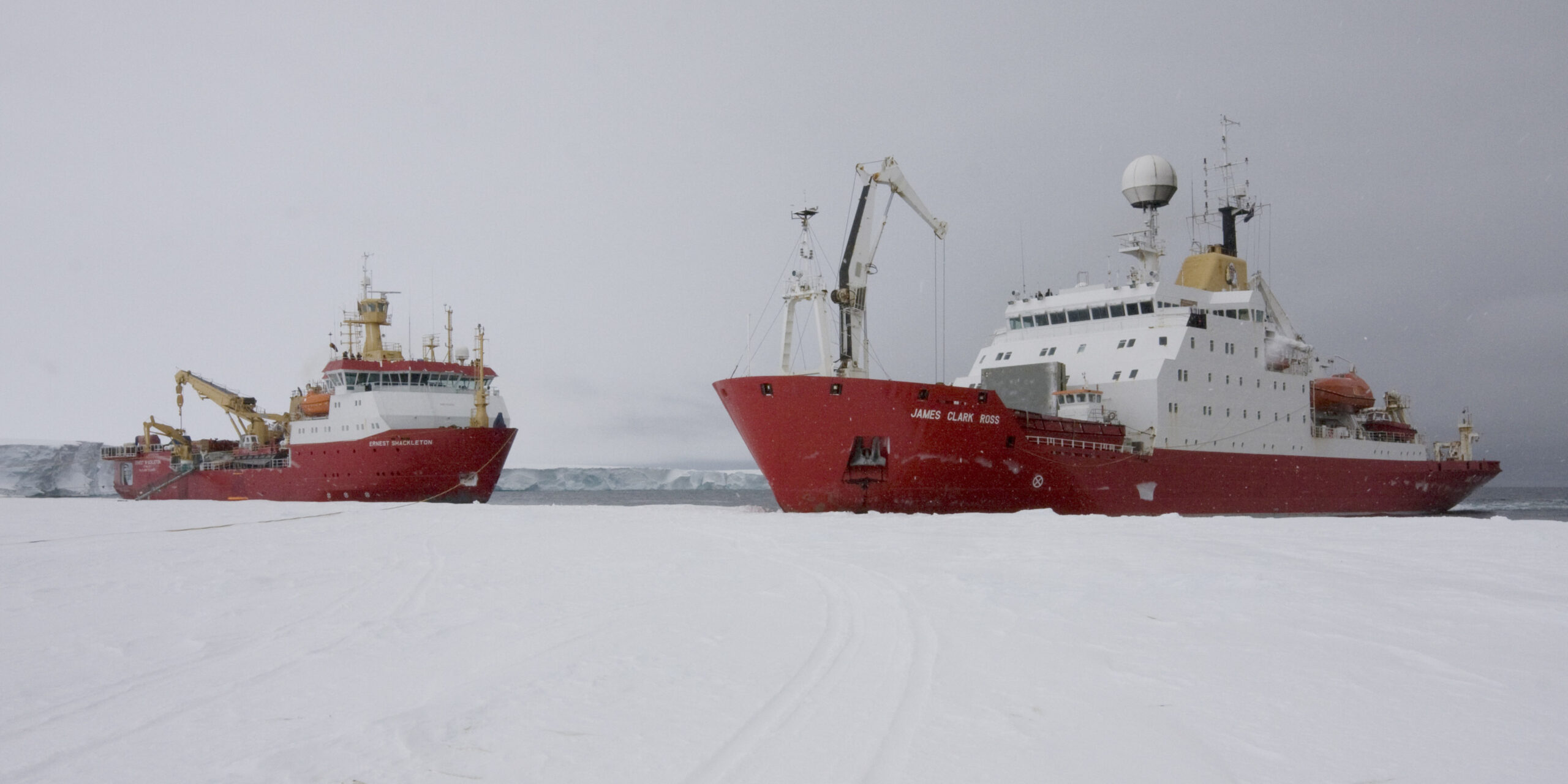
A rare coming together, with RRS James Clark Ross and RRS Ernest Shackleton tied alongside sea ice in the Weddell Sea
When RRS Bransfield was sold in 1999, RRS Ernest Shackleton took over logistical support under a long-term charter.
RRS John Biscoe
The second John Biscoe was built by Fleming and Ferguson Ltd, Paisley, for the Falkland Island Dependencies Survey (FIDS). Launched in 1956, passengers on her maiden voyage included HRH Prince Philip, the Duke of Edinburgh, visiting some of the FIDS research stations during the 1956/57 season.
Initially the ship operated as a cargo vessel to resupply FIDS – later BAS – research stations. Increasingly she supported hydrographic and marine biology surveys, and geological landings. Following a major refit in 1979, her role became that of a platform for marine science, particularly the Offshore Biology Programme. Modifications included replacement of the main engines, new laboratories, winches for sampling down to 3000 metres, a gantry for trawling and bow thruster to enable the ship to maintain station in strong winds and currents. New instrumentation included a satellite navigation system, echo-sounder and echo-integrator and salinity-temperature-depth profiler.
The ship’s original motor launch was destroyed in rough seas off Tristan da Cuhna on 11 Nov 1957. A replacement was built by John I. Thorneycroft and Co Ltd in 1958. Initially open-decked, a cabin and decking were added for use in hydrographic survey work.
During the 1985/86 season, the ship became trapped in sea ice near Wiencke Island. Crew were temporarily evacuated to the RV Polar Duke and Palmer station from 18-20 Nov 1985, when she was finally freed from the ice by the West German vessel, Polarstern.
Her final voyage with BAS took place during the 1990/91, returning to Grimsby on 10 May 1991.
Naming
Named after the English 19th-century sea captain, John Biscoe (1794-1843). In 1830, Biscoe was given command of the Tula by Enderby Brothers of London. Combining exploration with the search for new sealing grounds, Biscoe circumnavigated the Antarctic continent, discovering Enderby Land in 1831, Adelaide Island and the Biscoe Islands in 1832, as well as part of the west coast of the Antarctic Peninsula, naming it Graham’s Land (now Graham Coast).
Technical specification
- Lloyds classification: 100 A1 ice strengthened. Official Lloyds Registry no. 185050
- Dimensions: length 220ft (overall), 204.30ft (registered); breadth 40ft
- Propulsion: diesel-electric 1450 SHP
- Speed: 12 knots
- Tonnage (1992): gross 1554.20, registered 358.77
- Accommodation: 10 officers, 21 crew, 29 passengers
- The ship’s hull was originally grey, painted red in 1960.
Port of registry
Stanley, Falkland Islands
Post-BAS service/end-of-life
The John Biscoe was sold on 30 Sept 1992 to Fayza Shipping Tartous, renamed the MV Fayza Express and re–registered in Honduras. She continued to operate as a a cargo and passenger vessel out of Limassol, Cyprus. According to the Lloyds Register of Shipping she was broken up in Turkey, Mar 2004.
The John Biscoe‘s motor launch, sometimes referred to as the ‘Biscoe Kid’, was transferred to the RRS James Clark Ross and continued to be used until around 2002. She was then sold and subsequently bought by the Eyemouth Harbour Trust, Northumberland, which maintains a collection of historic small boats. She took part in the Queen’s Diamond Jubilee Thames Pageant on 3 Jun 2012.
RRS Shackleton
The RRS Shackleton was in service with the Falkland Islands Dependencies Survey (FIDS)/British Antarctic Survey (BAS) from 1955/56 until 1968/69. Her role was primarily that of a survey and science vessel, supporting marine geophysics programmes. Originally named the Arendal, she was built in 1954 at Sölvesborg in Sweden for Arendals Dampskibsselskab, Norway. In Aug 1955, she was bought by FIDS for £230,000, and further strengthened for work in sea ice. She was renamed RRS Shackleton by Mrs Arthur, wife of the then Governor of the Falkland Islands and Dependencies, in a ceremony at Southampton on 19 Dec 1955.
On 29 Nov 1957, having completed the relief of Base H, Signy Island, the vessel was north of Coronation Island, South Orkney Islands, when she collided with heavy pack ice and was holed in two places below the waterline. Number 2 hold filled with water but using the ship’s pumps and temporary repairs she was stabilised and, escorted by the whaling ship Southern Venturer and HMS Protector, put into Stromness Bay, South Georgia, for repair.
A second ship was also named after Ernest Shackleton in 1999.
Naming
Named after Sir Ernest Shackleton, 1874-1922, one of the most famous figures from the Heroic Age of Antarctic Exploration. Shackleton served on Scott’s Discovery Expedition (British National Antarctic Expedition), 1901-04, he led the Nimrod Expedition, (British Antarctic Expedition), 1907-09, but is most well-known for the Endurance Expedition (Imperial Trans-Antarctic Expedition), 1914–17 – a remarkable story of survival against the odds. Shackleton died during the Quest Expedition, (Shackleton-Rowett Antarctic Expedition), 1921-1922, and is buried in the whalers graveyard at Grytviken, South Georgia.
Technical specification
- Lloyds classification: 2-3 for ice
- Dimensions: length 200 ft 6 ins; breadth 36 ft 1 ins
- Loaded displacement: 1658 tons
- Gross tonnage: 1102 tons
- Propulsion: diesel engine, 785 SHP
- Speed: service speed 12 knots
Port of registry
Stanley, Falkland Islands
Post-BAS/end-of-life
From 1969, the Shackleton was operated by BAS’s parent body, NERC (Natural Environment Research Council) as an oceanographic research vessel. Under NERC ownership she carried out geophysical and marine geology cruises in Antarctic waters until being withdrawn from service in May 1983 and sold.
The Shackleton was renamed Geotek Beta in 1983, and Profiler in 1984. In 1992 she was reconfigured to operate as a soils and high resolution seismic survey vessel, operated by Gardline Shipping Limited of Great Yarmouth. Renamed Sea Profiler in 1992, she is believed to have still been operational in 2009. Her last port of call was Hull in 2010 and she was reportedly scrapped the following year.
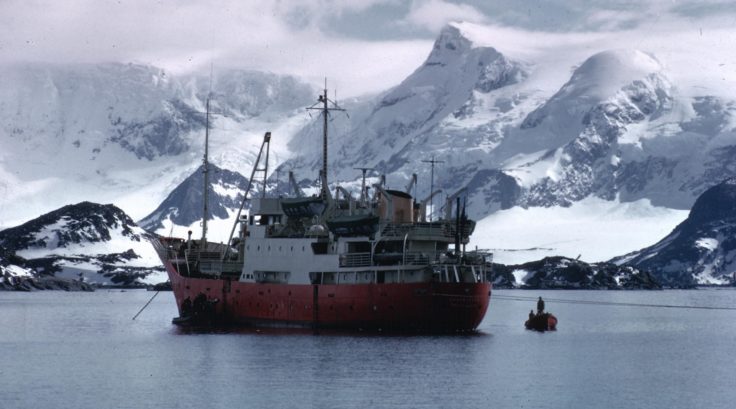
RRS Shackleton at Signy Island, 1968. (Photographer: Douglas Brown; Archives ref: AD6/19/3/B66)
RRS Bransfield
The RRS Bransfield was an ice-strengthened cargo vessel, purpose-built for operation by the British Antarctic Survey (BAS). She was launched at Leith on 4 September 1970, by Lady Joyce Fuchs, wife of the Survey’s then director, Sir Vivian Fuchs.
She was designed by consultants Graham & Woolnaugh of Liverpool for NERC, and built by Robb Caledon Shipbuilders Ltd, Leith.
The Bransfield was BAS’s main supply vessel from 1970/71-1998/99, and also had limited facilities for on-board research. She represented NERC in the Review of the Fleet at Spithead in 1977, held to celebrate Queen Elizabeth II’s Silver Jubilee.
Naming
The choice of the name honoured a British explorer who had made a significant contribution to the discovery of that part of Antarctica in which British research activities were centered at the time, namely the Antarctic Peninsula.
Edward Bransfield, Royal Navy (1785-1852) was either the master or navigator of HMS Andromache, based at Valparaiso, Chile, when news was received of a sighting of land further south than hitherto known. Bransfield commandeered a whaling brig, the Williams, and during 1819-20 discovered the north west coast of the Antarctic Peninsula, roughly surveyed the South Shetland Islands and claimed King George Island and Clarence Island for Great Britain. Bransfield was the first man to chart part of the Antarctic mainland.
This was in fact the second vessel to be named after Bransfield by BAS or its predecessors. The first HMS Bransfield was the original expedition ship for Operation Tabarin. This vessel was a wooden Norwegian sealer built in 1918 as the Veslekari, and renamed for the expedition. Her service with Tabarin was inglorious – she proved to be unseaworthy, and had to be replaced before the expedition left English waters in November 1943.
Technical specification
- Ice classification: Lloyds 100 A1 ice class A*
- Dimensions: length 325 ft (99.2m); breadth 60 ft (18.4m); draught 22 ft (6.7m)
- Tonnage 4816 gross, 1577 net
- Propulsion: Diesel-electric 5000 SHP (single variable pitch propeller)
- Passage speed: 13.25 knots (2 engines); 10.75 knots (1 engine)
- Endurance: 55 days (2 engines); 90 days (1 engine)
- Cargo capacity: 3450 cu m (max. theoretical capacity)
- Laboratory area: 550 sq ft
- Accommodation: 13 officers; 24 crew; 58 passengers
Port of registry
Stanley, Falkland Islands.
Post-BAS service/end-of-life
Following the ship’s return to the UK in May 1999, she was sold to Rieber Shipping A/S as part of the contract for the long-term charter of her replacement, RRS Ernest Shackleton and subsequently broken-up after passage to India.
RRS James Clark Ross
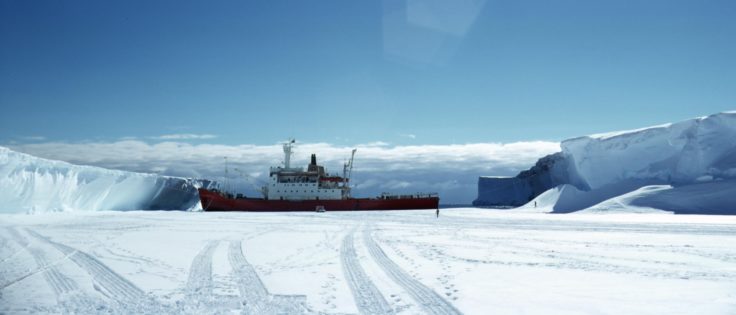
The RRS James Clark Ross was a purpose-built ice-strengthened research vessel for operation by British Antarctic Survey (BAS). She was launched at Wallsend on 1 December 1990, by Her Majesty Queen Elizabeth II.
She was designed and built by Swan Hunter Shipbuilders Ltd, Newcastle-Upon-Tyne, and entered service with BAS in 1991 to replace RRS John Biscoe.
The ‘JCR’ served as BAS’s primary oceanographic research vessel from 1991 until 2021, with extensive facilities for biological, oceanographic and geophysical research. The ship was equipped with sophisticated laboratory facilities and designed with an extremely low noise signature to allow deployment of sensitive acoustic equipment.
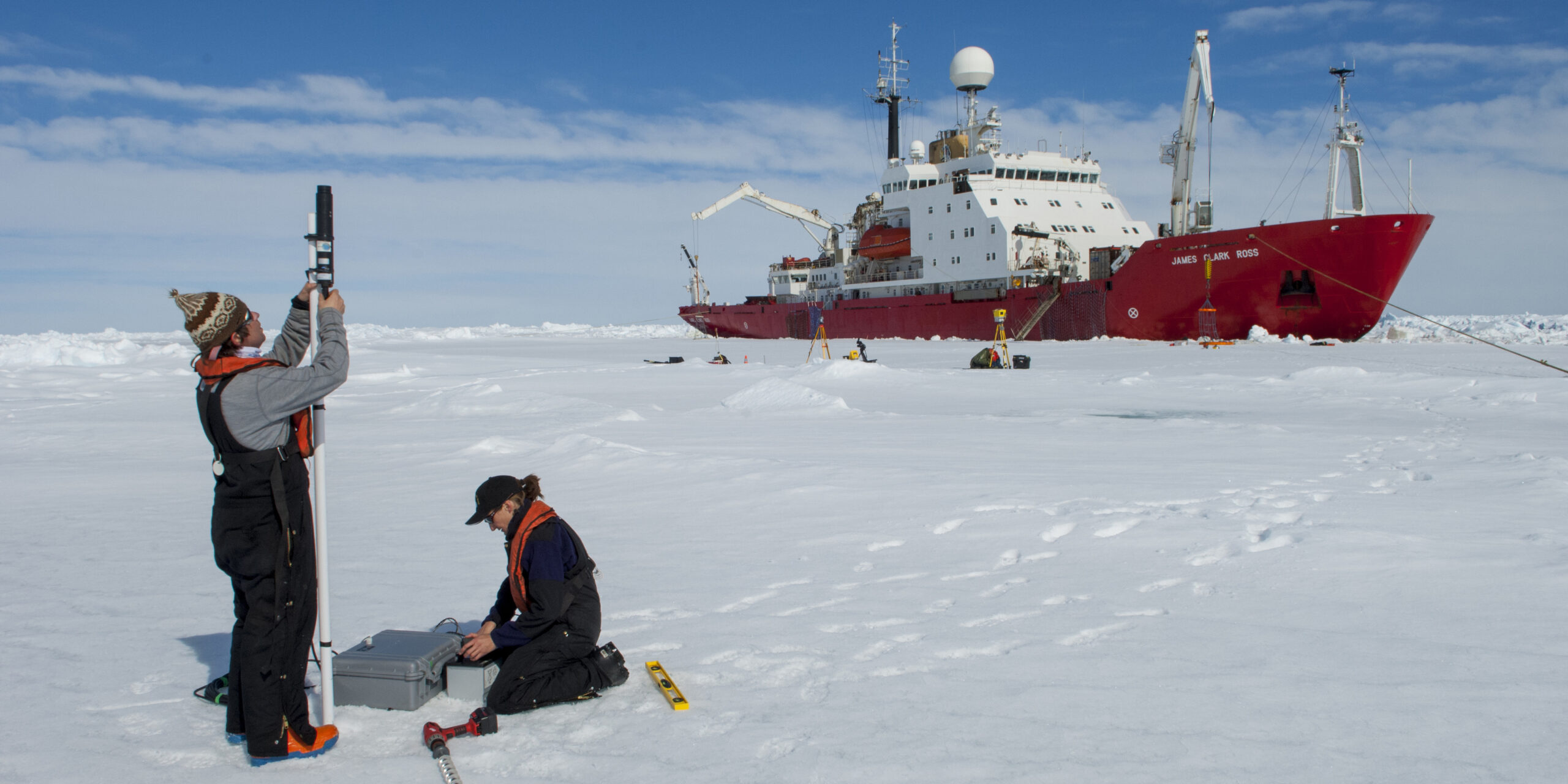
RRS James Clark Ross, in thick pack ice diruing the IceBell Cruise in the Bellingshausen Sea, Antarctica
During the Antarctic winter months, she often undertook scientific research on behalf of other organisations in Arctic waters, maximising her operational use throughout the year.
Naming
The choice of name honoured a distinguished British polar explorer who had made exceptional contributions to both Arctic and Antarctic exploration.
James Clark Ross, Royal Navy (1800-1862) discovered the North Magnetic Pole in 1831. Between 1839 and 1843, he commanded HMS Erebus on an Antarctic expedition that charted much of the continent’s coastline, discovered the Ross Sea, Ross Ice Shelf, and the volcanoes Mount Erebus and Mount Terror.
His expeditions produced the first accurate magnetic maps of the Antarctic and confirmed the existence of the southern continent. Ross was one of the most experienced polar explorers of the nineteenth century, having spent eight winters and fifteen navigable seasons in Arctic waters before his historic Antarctic voyage.
Technical specification
- Ice classification: Capable of steaming at 2 knots through sea ice one metre thick
- Dimensions: length 99.04m (325 ft); breadth 18.85m (62 ft); draught 6.4m (21 ft)
- Tonnage: 5,730 tonnes displacement; 5,372 gross
- Propulsion: Diesel-electric, 8,500 SHP (single variable pitch propeller)
- Ice-breaking features: Compressed air system to roll ship side-to-side, freeing passage through heavy pack ice; bow and stern thrusters
- Laboratory area: Multiple laboratories and facilities for five 20ft laboratory containers
- Accommodation: Officers and crew, plus scientific party
Port of registry
Stanley, Falkland Islands.
Post-BAS service/end-of-life
Following thirty years of service with BAS, the ship was sold to the National Antarctic Scientific Center of Ukraine in August 2021. She was renamed Noosfera and continues to operate in polar research and logistics support.
RRS Ernest Shackleton
The RRS Ernest Shackleton was an ice-strengthened logistics vessel, purpose-chartered for operation by British Antarctic Survey (BAS). She was launched in July 1995 at Leirvik, Norway, as MV Polar Queen.
She was built by Kverner Klevin Leirvik A/S, Norway, for GC Rieber Shipping of Bergen. BAS acquired her on a long-term bareboat charter in August 1999 to replace RRS Bransfield. The vessel was formally renamed RRS Ernest Shackleton on 13 May 2000 by Alexandra Shackleton, granddaughter of the polar explorer.
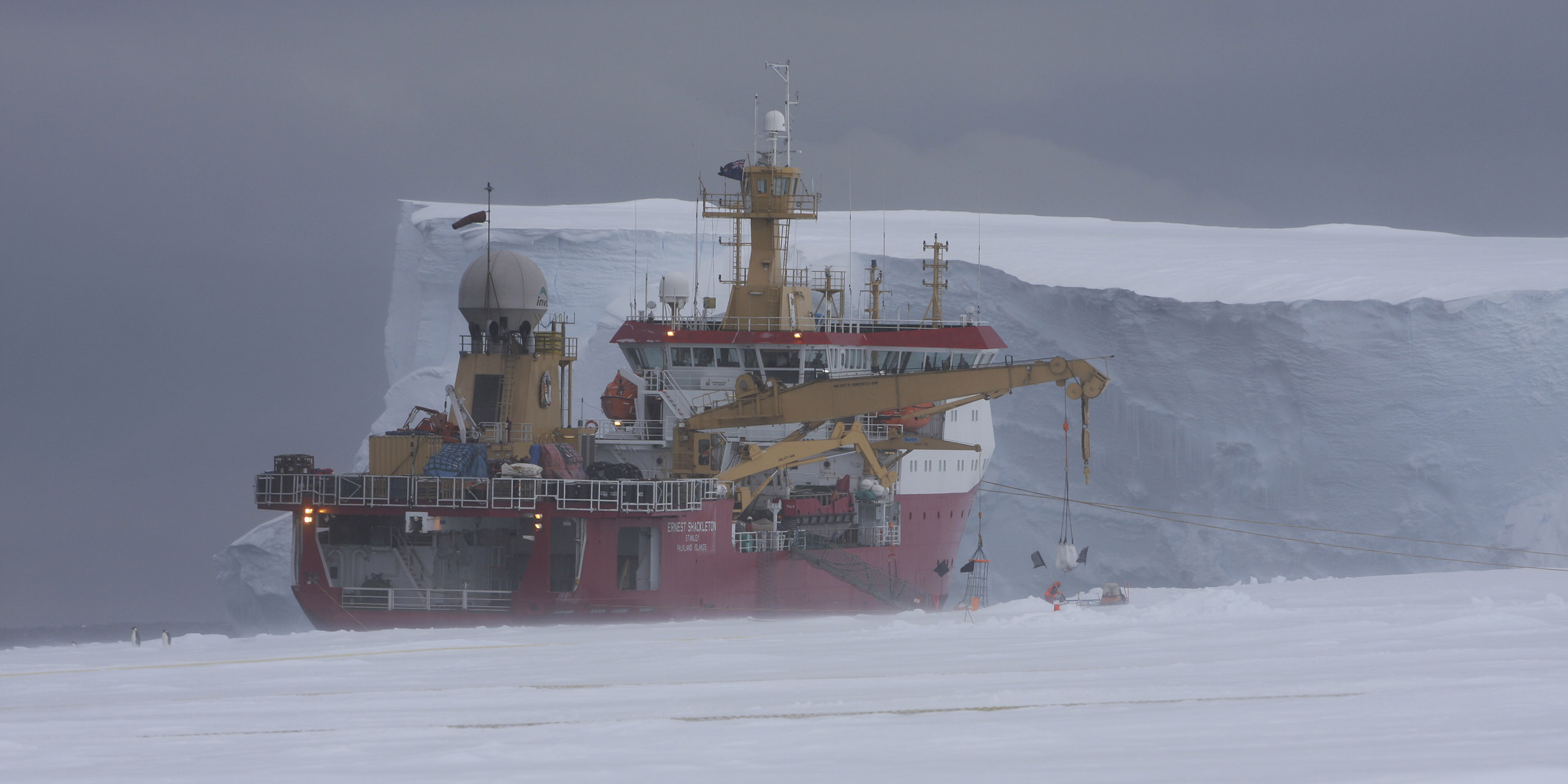
RRS Ernest Shackleton alongside the Brunt IceShelf, during a Halley Station relief
The Ernest Shackleton was BAS’s main logistics ship from 1999/2000 to 2018/19, primarily used for resupplying British Antarctic research stations with cargo, fuel and personnel. She also had basic scientific capability and undertook some research work.
Naming
The choice of name honoured one of the most celebrated figures of Antarctic exploration.
Sir Ernest Shackleton (1874-1922) was an Anglo-Irish Antarctic explorer who led three British expeditions to the Antarctic during the heroic age of Antarctic exploration.
Shackleton’s most famous expedition was the Imperial Trans-Antarctic Expedition of 1914-17 aboard Endurance, which, despite the ship being crushed by ice and the loss of the crossing attempt, became one of the greatest survival stories in exploration history. Through outstanding leadership, Shackleton brought all his men safely home after months stranded on the ice and an epic open boat journey to South Georgia.
This was the second vessel to be named after Shackleton by BAS or its predecessors. The first RRS Shackleton served FIDS/BAS from 1955 to 1983 as a supply and research vessel.
Technical specification
- Ice classification: Ice strengthened, double hull construction, Category A PC5 according to Polar Code
- Dimensions: length overall 80.0m (262 ft); length between perpendiculars 72.4m (238 ft); breadth moulded 17.0m (56 ft)
- Tonnage: 4,028 gross; 2,134 deadweight
- Draught: 7.3m (24 ft)
- Propulsion: Single screw controllable pitch propeller in nozzle from twin output/single output gearbox; azimuth thruster forward as emergency propulsion
- Environmental features: Oily water separator, incinerator, garbage compactor and waste water treatment according to Antarctic Treaty Environmental Protocol and MARPOL
Port of registry
Stanley, Falkland Islands.
Post-BAS service/end-of-life
After twenty years of polar duties for BAS, Ernest Shackleton was returned to her Norwegian owners on 30 April 2019. The vessel was subsequently acquired by the Italian National Institute for Oceanography and Applied Geophysics and renamed RV Laura Bassi. She continues to operate as an icebreaking research vessel, conducting Italian scientific expeditions to Antarctica.
RRS Sir David Attenborough
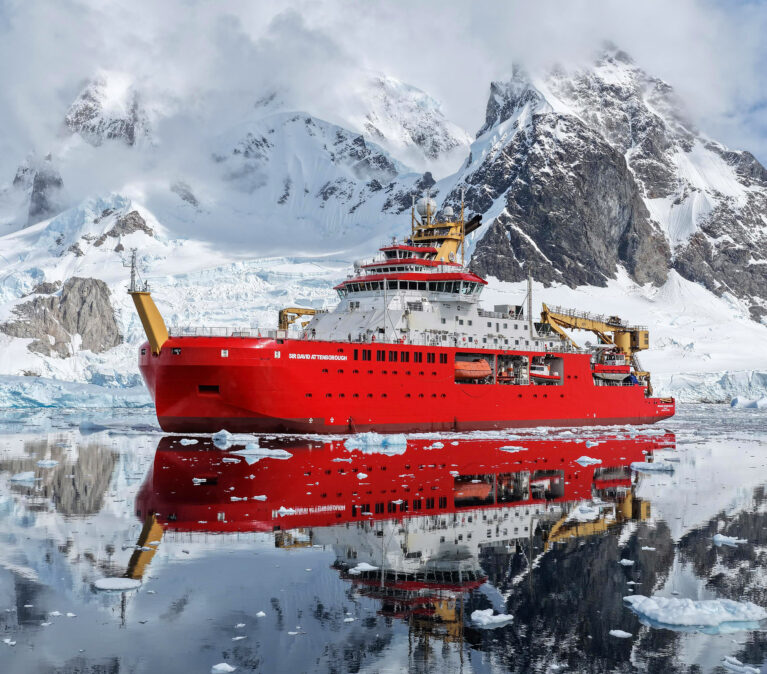
In 2021, RRS James Clark Ross and RRS Ernest Shackleton were replaced by RRS Sir David Attenborough. Plans for a single-ship operation had originally been considered in 1979–81, but later became unnecessary due to increased budgets following the South Atlantic conflict.
RRS Sir David Attenborough
Our state-of-the-art polar science ship provides scientists access to remote and challenging marine environments across the Antarctic and Arctic.
Royal Navy support
The Royal Navy has supported FIDS/BAS since the mid-1950s. This included hydrographic surveys, air photography, and helicopter support for scientific field teams from HMS Endurance.
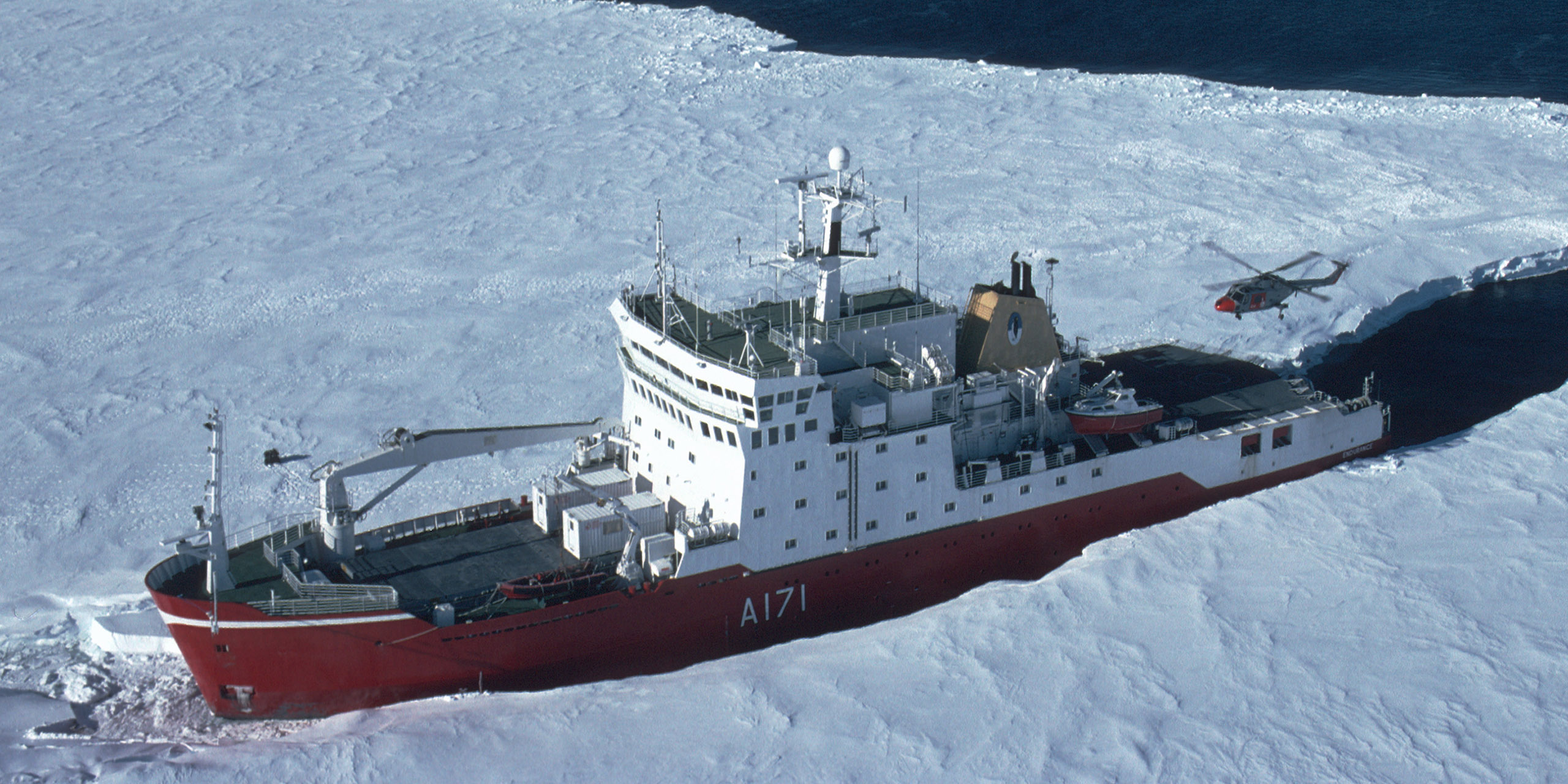
This partnership continues today, with HMS Protector supporting operations in 2015 in the South Atlantic and Antarctic Peninsula.
Additional resources
The British Antarctic Oral History Project features interviews with crew members, offering insight into daily life onboard.
Key terminology
- HMS – His/Her Majesty’s Ship
- MV – Motor Vessel
- RRS – Royal Research Ship
- SS – Sailing Ship