
British Antarctic Survey (BAS) has a unique governance structure that reflects its dual role as both a leading scientific research institute and a provider of logistical presence for the UK in the Antarctic and Arctic regions.
Organisational structure
BAS is a research centre of the Natural Environment Research Council (NERC), which is part of UK Research and Innovation (UKRI), a government department. This places us within the broader framework of UK government-funded science.
BAS is led by a director, supported by a leadership team that includes a director of science, a director of operations, and a director of innovation and impact. This structure is designed to deliver world-leading interdisciplinary research in the polar regions, efficient operations and a strong strategic direction.
Teams
In addition to our leadership team and science teams, we have teams for:
- operations, including engineering, operating research stations and operations delivery
- finance
- HR and well-being
- information technology
- communications
- information services
- innovation
- mapping and geographical information services
- transformation and strategy

Dual mandate
We have a dual role, defined in a memorandum of understanding between several UK government departments, including the Department for Science, Innovation and Technology (DSIT), the Ministry of Defence (MOD), and the Foreign, Commonwealth & Development Office (FCDO). These roles are to:
- deliver the UK’s strategic footprint in the British Antarctic Territory (BAT) and South Georgia & the South Sandwich Islands.
- manage a world-class science program as part of NERC, which helps to maintain the UK’s influence within the Antarctic Treaty System.
This dual mandate means that BAS conducts scientific research and provides advice to His Majesty’s Government on matters related to the Antarctic Treaty, environmental protection, and marine living resources.
Funding
The BAS annual budget is about £50 million. The majority comes from NERC, one of 7 research councils, operating under UKRI. NERC’s activities and funding decisions are independent of government.
Our accounts are published in NERC’s annual report and accounts. NERC’s delivery plan includes spending on Antarctic logistics and infrastructure.
FCDO allocates funds to us for:
- operating King Edward Point research station on South Georgia
- the Discovering Antarctica education and schools resource
- numerous environmental and research projects.
The MoD also provides logistical support for BAS operations, including HMS Protector for deployments and RAF air drops of essential fuel.
The European Union funds several of our European collaborations to investigate topics such as future changes in Arctic sea-ice, the impact of ocean acidification on marine invertebrates, and space weather research.
We expect this mix of funding to continue, and be supplemented by new sources from partnerships with other research institutions and businesses.
Relationship with the British Antarctic Territory
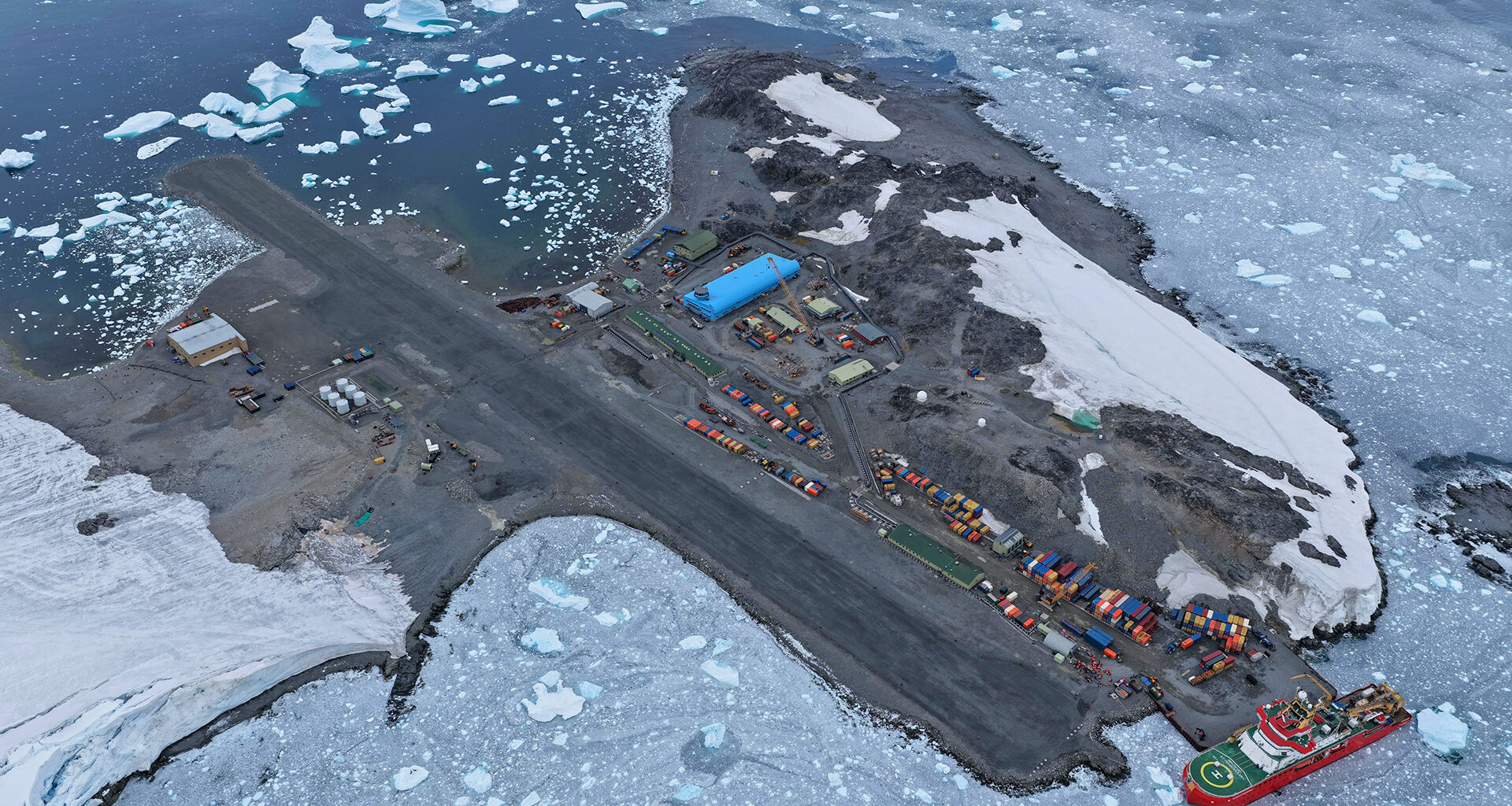
The British Antarctic Territory (BAT) is a UK overseas territory administered by the Polar Regions Department of the FCDO. There’s no formal government representation locally, but we operate 3 scientific stations within the Territory.
The UK’s claim to this part of Antarctica is the oldest, but all territorial claims are held in abeyance under Article IV of the Antarctic Treaty of 1959. Read more about Britain’s involvement in the Antarctic.
Accountability
We are accountable through NERC and UKRI policies and standards.